
Your cart
There are no more items in your cart
After a season or two outdoors, light marks, whitish patinas, and sometimes genuine white deposits appear on the surface of many terracotta pots. The first instinct is to see them as a flaw: in reality, this is a natural, physical phenomenon, and for many it's actually a sign of authentic, high-quality terracotta. The technical name for this phenomenon is salt efflorescence.
What is salt efflorescence?
It's a process whereby the mineral salts present in the material (or in the irrigation water) migrate through the porosity of the pot, reach the outer surface and crystallise there, forming small visible deposits.
The mechanism is simple. Water, whether from irrigation or rain, penetrates inside the pot.
Dissolved in the water are mineral salts, mainly calcium and magnesium, naturally present both in the pot's clay and in tap water. When the water evaporates through the porous walls, the salts remain behind and crystallise on the outer surface, forming the characteristic white veil.
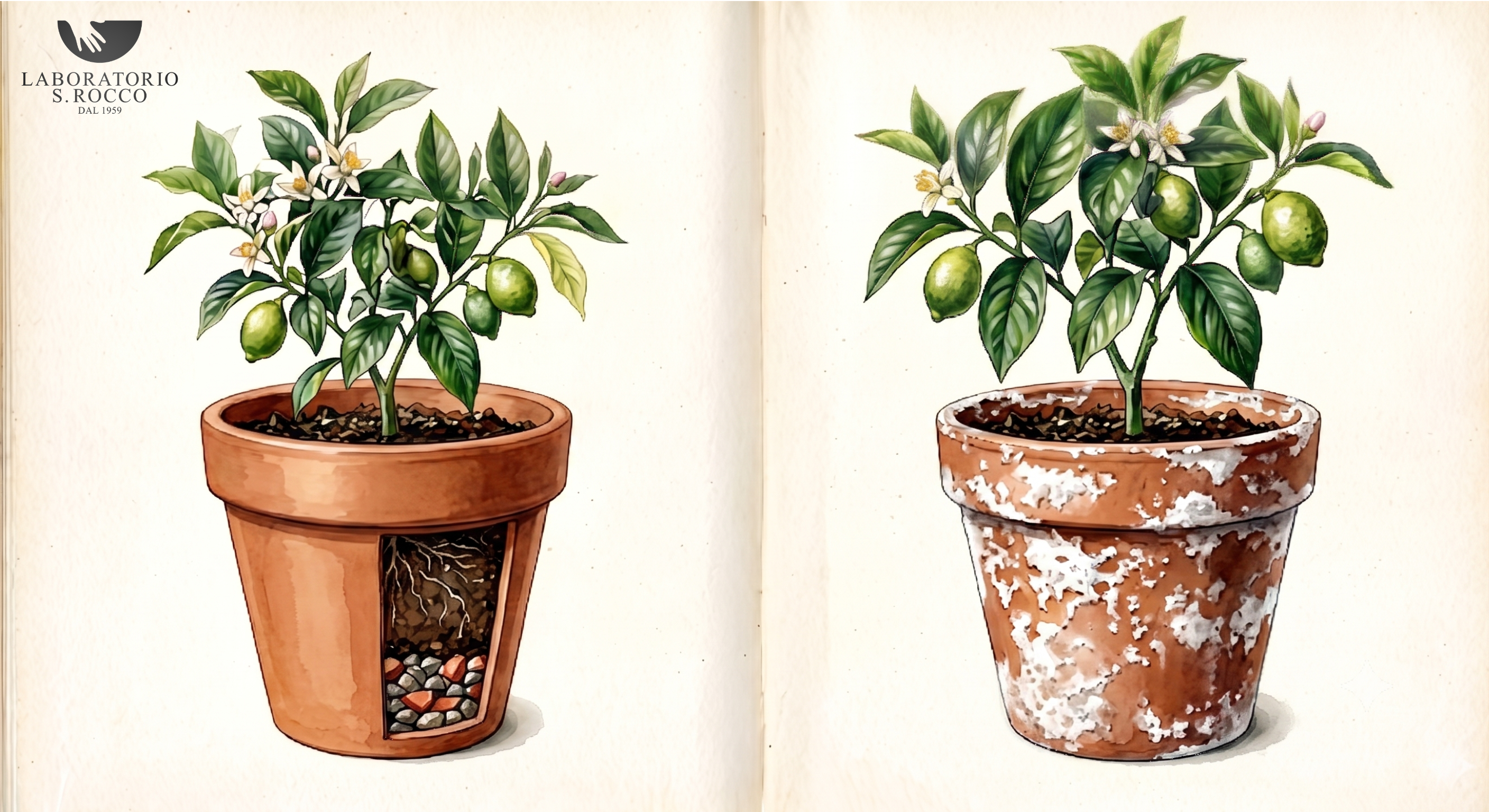
Is it a flaw?
No, efflorescence is not a flaw in the pot.
It's direct proof that the material is breathable and porous, meaning it's working exactly as it should. A pot that never develops efflorescence is probably a non-porous pot — in other words, a pot in which the roots can't breathe and the substrate can't dry out properly. You could say that efflorescence is the signature of an authentic material. Industrial pots made of resin or glazed ceramic never develop this phenomenon precisely because they aren't porous. But for that very reason, they don't offer any of the benefits of authentic terracotta.
The three sources of salts
The clay itself
Terracotta contains natural minerals — mainly calcium and magnesium salts — that are part of the original clay. In the first months of a pot's life, these salts emerge on the surface more frequently, because the internal concentration is higher.
Irrigation water
Tap water contains dissolved salts, in amounts that vary depending on the area. "Hard" water, typical of regions with calcareous subsoil, is particularly rich in calcium. Every watering brings new salts into the system.
Fertilisers
Fertilisers, especially liquid and mineral ones, add salts to the substrate. Heavy fertilising can significantly speed up the formation of efflorescence on the outer surface of the pot.
How it evolves over time: the patina
Over time, efflorescence doesn't remain as separate deposits but blends into the surface of the pot, becoming part of its patina.
New terracotta has a bright, uniform, glossy orange colour. After a year or two outdoors, the same terracotta develops warmer tones, softer shades, small colour variations that make it much richer aesthetically.
This ageing is highly sought after. Many people, especially those who tend historic gardens, period villas, formal landscapes, prefer pots that have already acquired a patina.
There are even "accelerated ageing" techniques to artificially achieve this effect on new pots, a sign of just how prized it is.
Can the formation of efflorescence be prevented?
Partly yes, but honestly, it's best to accept it.
Irrigation water
Using collected rainwater significantly reduces the input of external salts. Tap water, especially if very hard, is the main source of the salts that migrate to the surface.
Moderate fertilising
Use fertilisers at the recommended dosages without overdoing it. Heavy fertilising not only speeds up efflorescence but can also damage the roots through salt build-up in the substrate.
Waterproofing treatments
There are products that seal the pot's surface, preventing efflorescence.
It's a technically valid option but with a significant trade-off: you lose breathability, which is the main advantage of terracotta. Not recommended for pots growing plants; it can make sense for purely decorative pots that don't hold vegetation.
How to remove salt if you really don't want it
If you prefer to keep the pot "clean", efflorescence is easy to remove.
Here are the most effective methods, in order of gentleness.
Dry brush For surface, recent deposits, a brush with stiff but non-metallic bristles is enough. Scrub the affected area with circular motions. Works well for light efflorescence.
Water and brush For more stubborn deposits, lightly dampen the surface and then scrub with the brush. The water partially dissolves the salts and makes mechanical removal easier.
White vinegar and water solution
For the most stubborn build-up, prepare a solution of water and white vinegar at 10-20 percent (one glass of vinegar per litre of water). Apply with a sponge to the area to be cleaned, leave it to work for a few minutes, then scrub with the brush and rinse thoroughly. The acidity of the vinegar dissolves the calcium salts.
What NOT to use
Absolutely avoid: bleach, industrial degreasers, aggressive limescale removers, metal brushes. These products can alter the porosity of the material, damage the surface, or leave chemical residues that harm plants.
Frequently asked questions
Does efflorescence harm the plant?
No, it's a phenomenon external to the pot that has no effect at all on the plant. The salts that pass through the wall crystallise on the outside; they don't enter the substrate.
Are they dangerous for pets?
No, they're simple mineral salts (mainly calcium carbonate). They aren't toxic, although it's obviously not advisable for animals to ingest them.
Why do some pots develop more efflorescence than others?
It depends on the porosity of the material, the pot's exposure (more sun = more evaporation = more efflorescence), the hardness of the irrigation water, and the intensity of fertilising. Two identical pots placed in two different settings will develop differently in appearance.
Does efflorescence come back after being removed?
Yes, if the conditions don't change. Removal is temporary — the phenomenon reappears. That's why many people prefer to accept it: the resulting patina is part of the pot's natural life.
The new pot already has salt on it, is that normal?
Yes. In the early stages of a pot's life, especially if it has been exposed to humidity during storage or transport, it may already show slight efflorescence. This is entirely normal and doesn't indicate a quality problem.