
Your cart
There are no more items in your cart
"Is it frost-resistant?" — this is the most common question asked by anyone buying outdoor terracotta pots. The answer calls for a little terminological clarity and some background on how terracotta physically behaves in winter.
Glossary: frost-damageable, frost-resistant, anti-frost
The three terms are often used interchangeably, but they have distinct meanings.
1. Frost-damageable
A material is frost-damageable when it suffers damage from freezing. Low-fired terracotta, made with porous clays and fired at insufficient temperatures, is frost-damageable: it cracks, flakes or breaks when water absorbed into its walls freezes and expands.
2. Frost-resistant
A material is frost-resistant when it withstands repeated freeze-thaw cycles without damage. High-quality terracotta, fired at high temperature (above 1,000°C) with selected clays, is frost-resistant. Every Laboratorio San Rocco pot is made from Galestro and is certified frost-resistant.
3. Anti-frost
A less technical but widely used commercial term — it's synonymous with frost-resistant in marketing language. It indicates that the product is designed to withstand frost.
Why do some pots crack in frost?
The phenomenon is purely physical. Water expands by around 9% when it freezes.
If that water is held inside a porous material — like terracotta — and the material has absorbed a significant amount, the expanding ice exerts internal pressure on the material's walls. If the structure isn't dense and cohesive enough, the walls crack. In a frost-damageable terracotta pot, typical damage includes: micro-cracks that spread over time, surface flaking (known as "spalling"), vertical or horizontal cracks, and in the worst cases, complete breakage. Once the process starts, even a single harsh winter can shorten the pot's life.
The frost-resistance certification for Galestro pots covers the climate conditions typical of continental Europe, including northern Italy, Austria, Germany and Poland. Overnight frosts down to -15°C, even prolonged ones, are not a problem for the material. For more extreme conditions — mountain sites above 1,500 metres, extreme continental climates — the protective measures described above are still recommended.
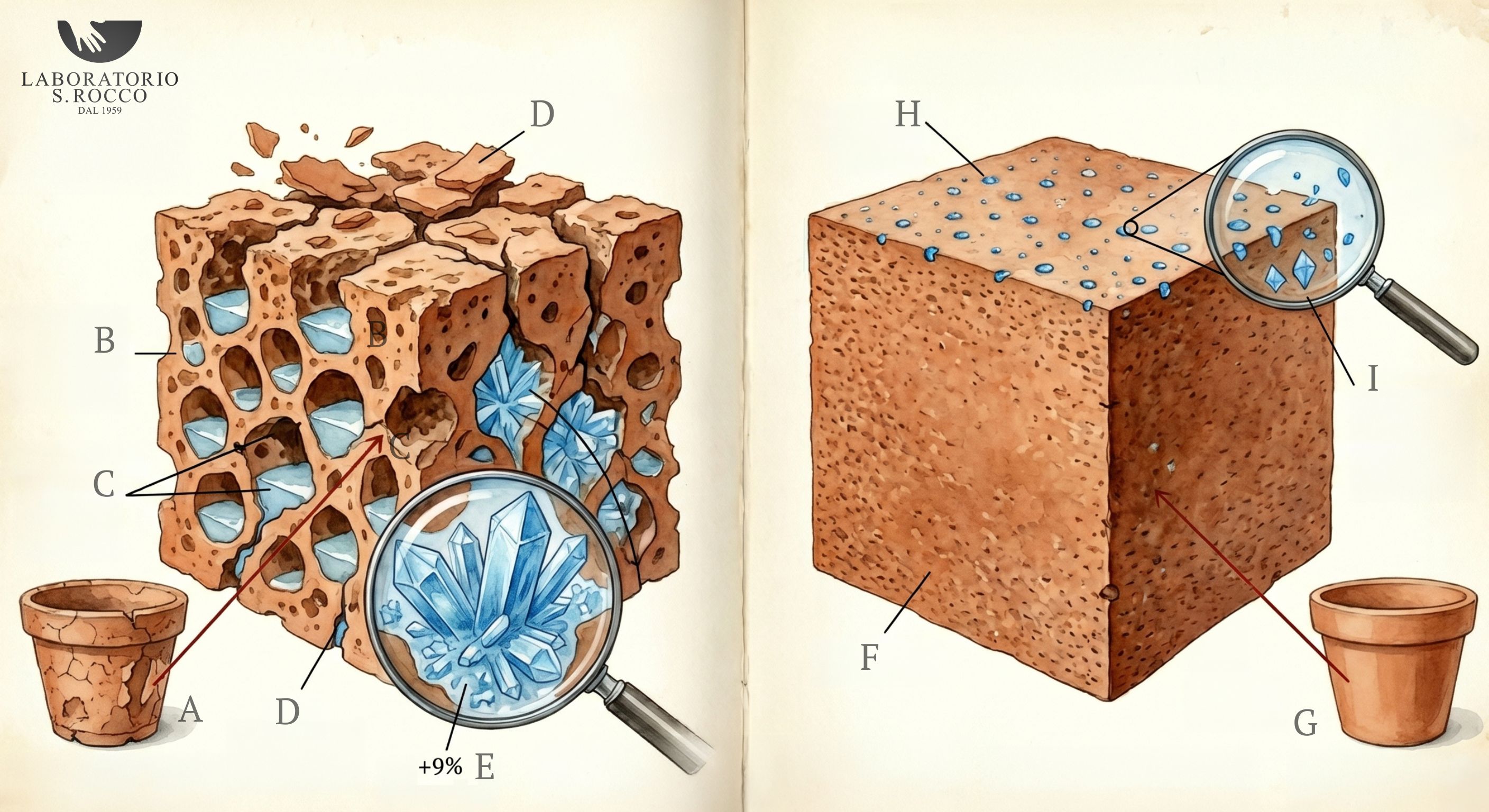
Caption:
A: Terracotta pot with visible frost damage; B: Porosity; C: Trapped micro-cracking; D: Surface micro-cracking; E: Ice expansion trapped within micro-cracks;
F: Intact porosity; G: Intact terracotta pot; H: Minimal water absorption; I: No internal/external ice expansion
What makes a pot frost-resistant
The starting clay
Selected clays, blended to achieve the right combination of plasticity, firing shrinkage and final density, are the first factor. Industrial blends use standardised clays; artisanal Tuscan production uses clays selected from the region, with superior characteristics.
Firing temperature
A pot fired at 900°C has very different characteristics from one fired at 1,000°C or 1,050°C. Higher firing produces a denser structure with reduced micro-porosity — meaning lower water absorption and greater frost resistance. Terracotta from Impruneta is traditionally fired at around 1,000-1,050°C.
Firing time
The firing profile matters too: a slow rise in temperature, an extended hold at peak temperature, and a controlled cool-down all produce a more stable piece compared to fast industrial firing.
Galestro
This is the blend of Italian clays developed and patented for producing pots intended for outdoor use. It is the quality benchmark in the industry: certified frost-resistant, it is the raw material used by Laboratorio San Rocco for its entire production.
When even a frost-resistant pot can crack
This is the part that's often underestimated. Frost-resistance certification concerns the pot's material — not its contents. If the substrate inside the pot is saturated with water and that water freezes, the expanding ice can exert enough internal pressure to deform or crack even a top-quality pot. The typical risk situations are:
Insufficient drainage
A pot without an effective drainage hole accumulates rainwater in the substrate. In autumn, after weeks of rain, the soil is saturated. The first hard frost arrives: the water in the substrate freezes, expands, and pushes against the walls.
A full saucer
A saucer full of water that freezes creates pressure from below. The pot, frozen to the saucer, can crack at its base.
Pot resting directly on the floor The same scenario: rainwater collects in the puddle formed by the floor beneath the pot, freezes, and damages the base. This is why pot feet are recommended — they keep the pot raised off the supporting surface.
How to protect your pots during winter
Cut back on watering in autumn From mid-autumn onwards, gradually reduce watering frequency. Plants in vegetative dormancy need very little water. A drier substrate going into the cold season is safer.
Raise pots off the ground
Use terracotta feet or dedicated stands to keep the pot clear of the surface. Rainwater needs to drain away freely.
Shelter small pots
For small pots — under 30 cm in height — consider moving them under cover or into a sheltered spot during the harshest months. Their lower thermal mass makes them more vulnerable to temperature swings.
Use a more free-draining substrate
In autumn, if you're repotting a plant, use a more free-draining substrate (more sand, perlite, lapillus) to reduce its water retention over winter.
Frequently Asked Questions
Are Laboratorio San Rocco pots guaranteed against frost?
The pots are made from certified frost-resistant Galestro. The guarantee covers material defects; it does not cover damage caused by improper use (a frozen, waterlogged saucer, blocked drainage, pots left standing in pools of rainwater). By following basic precautions — free drainage, pot feet, reduced winter watering — the pots last for decades even in regions with harsh winters.
What does the rating "M -15°C" or similar mean?
These are indications from some manufacturers regarding the minimum guaranteed operating temperature. Galestro pots don't have a strict temperature limit, because resistance also depends on the material's moisture content and the speed of temperature change. Good practice matters more than any single number.
Can I leave the pots outdoors during winter?
Yes, that's the natural condition for quality terracotta pots. There's no need to bring them indoors — just follow the precautions described: free drainage, raised pot, reduced watering.
Can the pots be treated with waterproofing products?
Not recommended. Waterproofing products seal the material's porosity — the very porosity that allows root transpiration and moisture regulation.
Doing so risks turning a breathable pot into a sealed, impermeable one, with negative effects on plant health. Quality terracotta doesn't need any additional treatment.