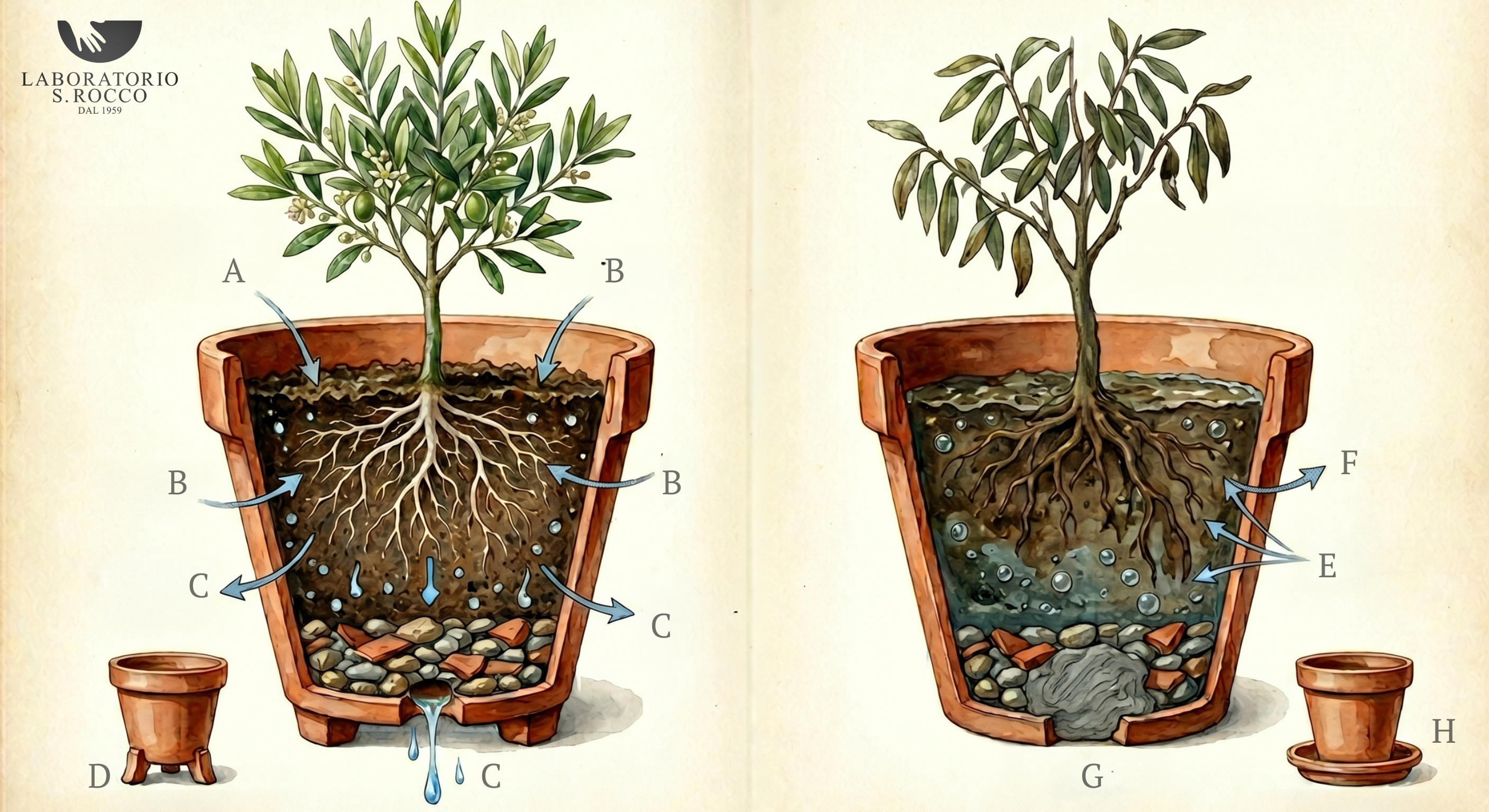
That small hole at the bottom of every terracotta pot — simple, often overlooked, sometimes even accidentally sealed — is actually the most important element for the health of the plant and for the longevity of the pot itself. Let’s find out why.
What the drainage hole is for
The drainage hole has a precise function: to allow excess irrigation water and rainwater to flow out of the pot. Without this outlet, water becomes trapped in the substrate and the phenomenon known as waterlogging occurs, leading to soil saturation and root rot.
The roots of most plants need to alternate between phases of moisture and phases of drying out. They need water, but they also need oxygen — and when the substrate is completely saturated with water, oxygen is expelled from the soil and the roots suffocate. Root rot is one of the most frequent causes of death in potted plants.
It is not uncommon to see pots where the drainage hole has been sealed — with putty, sealant, or a glued stone — to prevent water from staining the floor underneath. This is a serious technical mistake. Even a partially blocked hole seriously compromises the health of the plant. If the problem is water seeping out and wetting the surface below, the correct solution is not to close the hole but to raise the pot off the ground using terracotta feet or a suitable saucer. Let’s look at both solutions in more detail.
Terracotta pot feet.
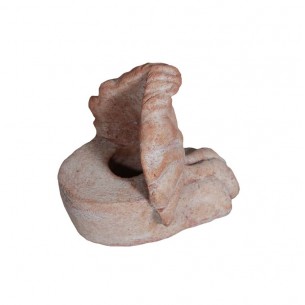
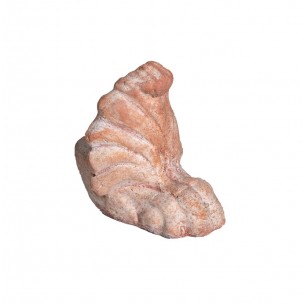
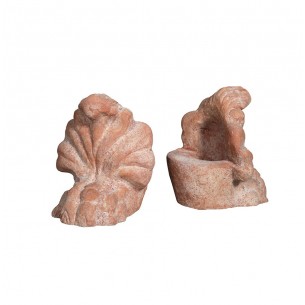
Terracotta pot feet are small supports, generally sold in sets of three or four, placed under the pot to raise it 5–10 cm off the surface. They are the most elegant and technically correct solution for managing drainage in large pots.
The benefits are tangible: they allow the free flow of water from the drainage hole. They keep the surface below the pot dry — particularly important on wooden, marble, terracotta tile or outdoor parquet terraces. They improve air circulation around the base of the pot, reducing the risk of mould and deposits. In winter they protect both the pot and the surface from continuous contact with frozen water.
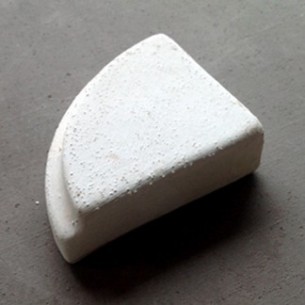
We produce feet in several sizes: Small Foot (for small and medium pots), Large Foot (for large pots and jars), Corner Foot (for corner positioning), Multi-foot (multi-format), and the Universal Foot, suitable for almost all shapes.

Legend:
A: Correct irrigation; B: Oxygen; C: Excess water, drainage outflow; D: Example of raising foot; E: Water stagnation; F: Root and soil rot; G: Blocked drainage hole; H: Example of saucer
Saucers: pros and cons
The saucer is a traditional solution but must be used with care. It works well for indoor environments where drainage water needs to be collected, but outdoors it can cause problems if not managed correctly.
When the saucer works well
It is fine for houseplants, where the water collected in the saucer can be emptied regularly after watering. It is also useful on balconies above other apartments, where dripping onto neighbours below must be avoided.
When it causes problems
Outdoors and for Mediterranean plants, the saucer can become a trap: rainwater accumulates, the roots constantly draw from it, and the substrate remains permanently saturated. For olive trees, rosemary, lavender and citrus fruits this is the surest way to make the plant sick.
The operational rule.
If you use a saucer, empty it within 30 minutes of watering. If it rains, check afterwards that it has not filled up. For Mediterranean plants in full sun in an outdoor pot, seriously consider replacing the saucer with pot feet.
Large pots and multiple holes
In large pots — jars, urns, substantial planters — a single central hole may not be sufficient for the volume of water to drain during heavy rain.
Many large pots are produced with a single larger-diameter hole, or with several holes distributed across the base.
If you have a large pot with a single hole that seems small relative to the volume, you can:
a) ensure a very generous drainage layer (10–15 cm) above the hole, so that it acts as a drainage reserve; b) raise the pot further with feet to facilitate the evacuation of large volumes of water.
Drainage and frost protection
There is a direct link between efficient drainage and frost resistance.
Water, when it freezes, increases in volume by approximately 9%.
If a pot contains water-saturated soil when a frost arrives, the expansion pushes against the walls with enormous force — and even a frost-resistant certified pot can crack or shatter.
Good drainage prevents this situation: even during winter the substrate does not remain saturated, rainwater drains away, and ice expansion is kept to a minimum. The drainage hole is in effect the first line of defence against winter damage.
Frequently asked questions
Not recommended. Fired terracotta is strong but brittle when drilled: the risk of causing a crack that will spread over time is high. If the existing hole seems insufficient, focus instead on building a generous and well-structured internal drainage layer.
All Laboratorio San Rocco terracotta pots have at least one drainage hole. Pots sold commercially without a hole are designed as decorative pot covers: the actual plant remains in its inner plastic pot with a hole, and the decorative pot simply contains and beautifies it.
Do not block the hole, but protect it from becoming clogged: place a terracotta shard over the hole, concave side facing down, like a small umbrella. It prevents fine soil from falling through and blocking the hole, keeping the water passage clear.
There is no fixed rule: a single hole of adequate diameter is sufficient when paired with a generous internal drainage layer. Industrial plastic pots have many small holes; handcrafted terracotta pots typically have a single larger hole. Both solutions work well when properly configured.